
Can Faster Menu Decisions Improve Lunch-Service Profitability?
During lunch service, restaurant operators often focus on reducing food preparation and delivery times.
Those areas are important, but another part of the customer journey can also affect service capacity:
The time between receiving the menu and placing the order.
When customers take longer to decide, the delay may affect order capture, kitchen sequencing, food delivery, payment, and the time at which a table becomes available for the next customer.
A clearer menu may help reduce unnecessary uncertainty, particularly for first-time customers and for dishes that are difficult to understand from their names alone.
Text Alone May Not Provide Enough Information
Customers who are unfamiliar with a restaurant may not know its signature dishes, portion sizes, ingredients, presentation style, or flavor profile.
A menu may list items such as:
- House burger
- Pasta of the day
- Chef’s lunch plate
- Seasonal special
These names may be accurate, but they do not necessarily help the customer visualize the final dish.
The customer may still want to know:
- How large is the portion?
- What ingredients are included?
- How is the dish presented?
- Is it light or substantial?
- Is it similar to what I expect from the description?
- Does it represent good value at the listed price?
When the available information does not answer these questions, customers may require more time or ask staff for an explanation.
They may also select the most familiar or lowest-risk option rather than the dish the restaurant would prefer to promote.
This can create a mismatch between customer choice and the restaurant’s commercial priorities.
The restaurant may want to promote:
- A signature item
- A dish with a strong contribution margin
- A product that can be prepared efficiently during peak periods
- A seasonal item
- A dish that introduces the restaurant’s concept
However, these items may be overlooked when the menu does not communicate them clearly.
Research indicates that food photographs can influence customer attitudes, purchase intentions, and willingness to pay, although the effect depends on factors such as the item name, image quality, customer preferences, and presentation context. Pictures should therefore be treated as decision-support information rather than simple decoration.
Customer Decision Time Can Also Consume Staff Capacity
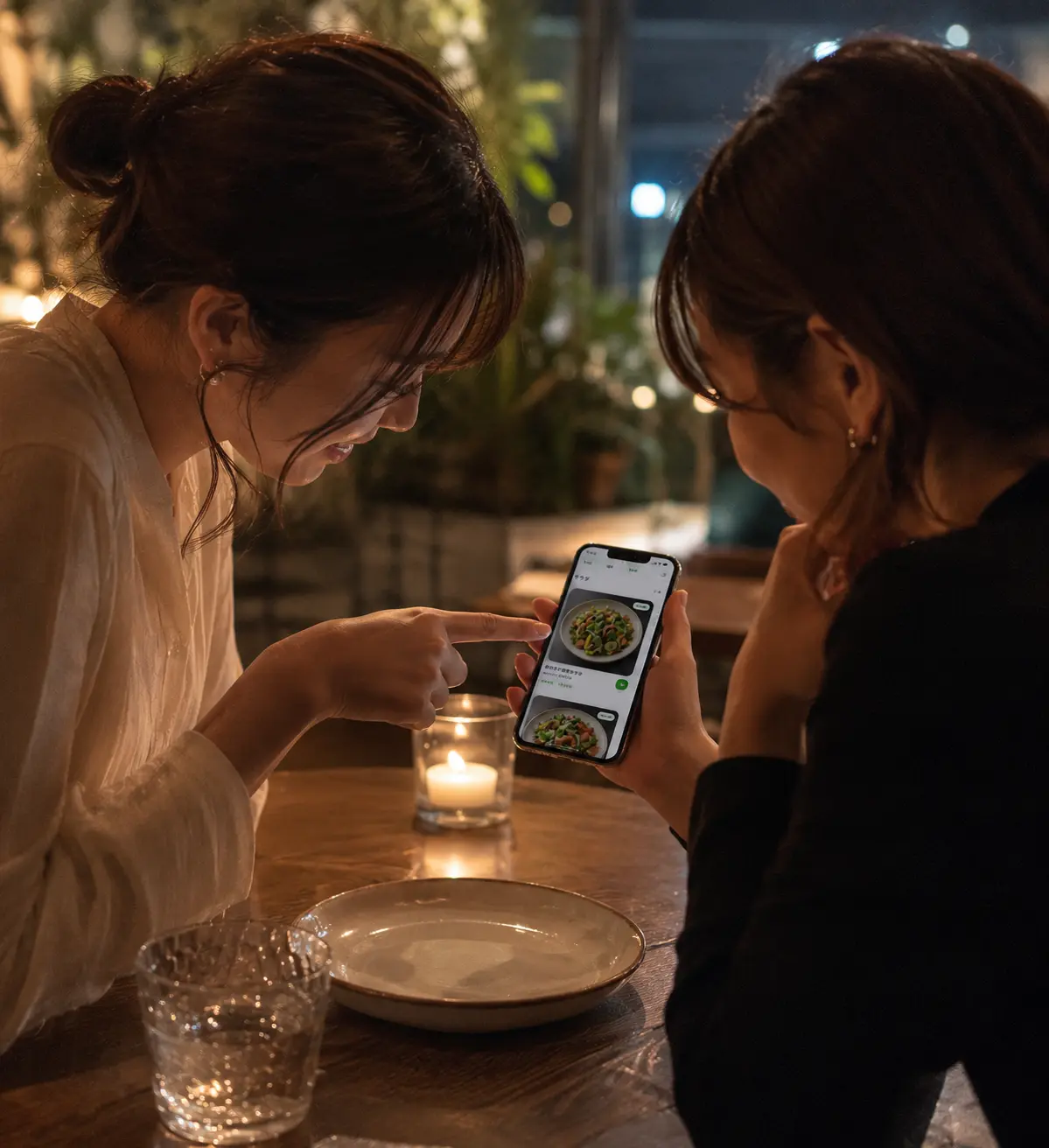
When a customer has not decided, a staff member may need to wait or return to the table later.
Typical exchanges include:
- “Could we have another minute?”
- “Which item do you recommend?”
- “What is included with this dish?”
- “How large is the portion?”
- “What does this item look like?”
- “Which dishes can be served quickly?”
These questions are a normal part of hospitality, and personal recommendations can add value.
During a short and busy lunch period, however, repeated explanations can consume significant front-of-house capacity.
A delay at the menu-selection stage can affect the sequence of the entire visit:
- The order reaches the kitchen later.
- Preparation begins later.
- Food is delivered later.
- Payment may occur later.
- The table may become available later.
This does not mean that every minute saved in menu selection will produce an equal reduction in total table time.
Kitchen capacity, customer behavior, payment speed, table clearing, queue demand, and party size also affect turnover.
The more supportable conclusion is that menu decision time is one component of the complete service cycle and should be measured rather than ignored.
A large or poorly structured range of options may also increase perceived choice difficulty. Research on restaurant choice overload suggests that the effect varies by context, including time pressure, customer goals, and the perceived number of alternatives.
Food Photography Is a Decision Tool, Not Just Decoration
The primary purpose of a menu photograph is not to make the menu look more elaborate.
It is to communicate information that may be difficult to express through a short description.
A useful image may show:
- Approximate portion size
- Main ingredients
- Presentation
- Accompaniments
- Texture
- Color
- Serving format
For a first-time customer, this can reduce the difference between what the menu describes and what the customer imagines.
The image can help answer a basic question:
“Is this the type of dish I expect to receive?”
That additional confidence may make the decision easier.
Photographs can also help restaurants draw appropriate attention to selected items. Studies of menu presentation indicate that visual and informational design can influence attitudes and purchase intentions, although observed effects on actual purchases are generally smaller and less consistent than effects on stated intentions.
This distinction matters.
An attractive photograph does not guarantee that a customer will order the item. The image must be supported by:
- An accurate name
- A useful description
- A clearly displayed price
- Honest portion representation
- Relevant dietary or allergen information
- Reliable product availability
- Consistent food presentation
Misleading or heavily edited images may create expectations that the kitchen cannot meet, which can damage customer trust.
What Could a One-Minute Reduction Mean During Lunch?
A neutral capacity model can help operators estimate the possible effect.
Illustrative assumptions
| Item | Assumption |
|---|---|
| Lunch-service duration | 120 minutes |
| Available seats | 20 |
| Average customer visit | 40 minutes |
| Menu decision time within that visit | 4 minutes |
| Potential reduction in decision time | 1 minute |
| Average transaction value | 12 currency units |
If the full minute is reflected in total table occupancy, the average visit would decline from 40 minutes to 39 minutes.
Theoretical capacity
| Metric | Current process | Revised process |
|---|---|---|
| Average visit duration | 40 minutes | 39 minutes |
| Theoretical uses per seat | 3.00 | 3.08 |
| Theoretical capacity across 20 seats | 60.0 customers | 61.5 customers |
| Theoretical sales capacity | 720 currency units | 738 currency units |
The theoretical difference is approximately:
- 1.5 additional customers
- 18 additional currency units per lunch period
- 360 additional currency units over 20 lunch services
This is a capacity calculation, not a revenue forecast.
The restaurant will only generate the additional sales when:
- Demand exceeds the existing seat capacity
- Customers arrive at times when the additional capacity can be used
- The kitchen can process the extra orders
- Tables can be cleared and reset promptly
- Payment and departure are not the primary constraints
- The reduction in decision time produces a corresponding reduction in total visit duration
For a restaurant that regularly has empty seats, reducing menu-selection time may improve the customer experience without increasing customer volume.
The financial value may instead come from:
- Reduced staff explanation time
- Better promotion of profitable items
- Fewer misunderstandings
- More efficient kitchen sequencing
- Increased conversion of additional orders
- Improved customer satisfaction
The operator should therefore identify the actual constraint before treating table turnover as the main objective.
Contribution Margin Matters More Than Revenue Alone
Faster decisions are not valuable if customers are directed toward items that produce weak margins or disrupt kitchen operations.
Restaurants should evaluate promoted menu items using contribution margin:
Contribution margin = selling price − item-level variable cost
Variable costs may include:
- Ingredients
- Packaging
- Payment or platform charges
- Item-specific preparation costs
- Waste
- Complimentary components provided with the item
A menu photograph may create more value when it supports an item that is:
- Popular or likely to appeal to the target customer
- Profitable after variable costs
- Operationally manageable during lunch
- Consistent with the restaurant’s positioning
- Available reliably
- Easy for the customer to understand
The objective is not simply to make customers decide faster.
It is to help them make an informed decision that works for both the customer and the restaurant.
Not Every Menu Item Requires a Photograph
Introducing menu photography does not require professionally photographing every product at once.
A practical first stage is to prioritize the items where an image is most likely to provide useful information.
Start with:
-
Priority items
Signature or strategically important dishes the restaurant wants customers to notice.
-
High-contribution items
Products that generate an attractive contribution margin after variable costs.
-
Unfamiliar items
Dishes that first-time customers may not understand from the name alone.
-
Visually distinctive items
Products whose presentation, portion, or ingredients are difficult to communicate through text.
-
Peak-period items
Dishes that can be produced reliably and efficiently during the busiest service periods.
-
Items that generate frequent questions
Products that repeatedly require staff explanation.
-
Seasonal or limited products
Items that need to be added, promoted, updated, or removed quickly.
A smaller set of accurate, useful images is generally preferable to a complete menu of inconsistent or outdated photographs.
Images should be reviewed whenever the recipe, portion, garnish, plate, packaging, or presentation changes materially.
Clear Menu Structure Is as Important as Photography
Images alone will not solve a poorly organized menu.
Customers also need a clear information structure.
A practical digital or printed menu should make it easy to identify:
- Product categories
- Item names
- Short descriptions
- Prices
- Variations and add-ons
- Dietary or allergen information
- Availability
- Recommended or signature products
- Ordering instructions
The menu should avoid using photography in a way that makes scanning more difficult.
For example, displaying a large image for every minor variation may require excessive scrolling on a smartphone. A better approach may be to use photographs selectively for products where visual information has a clear purpose.
Operators should test the menu on the device and in the environment where customers will use it.
Important questions include:
- Can customers understand the main categories quickly?
- Can they compare relevant products?
- Are prices visible before selection?
- Is the text readable?
- Are the photographs accurate?
- Is the order button easy to find?
- Can customers return to a previous category?
- Can they request staff assistance?
The most effective design is not necessarily the most visually complex.
It is the design that helps the customer reach an informed decision with minimal confusion.
Qroda Allows Menu Images to Be Updated Digitally
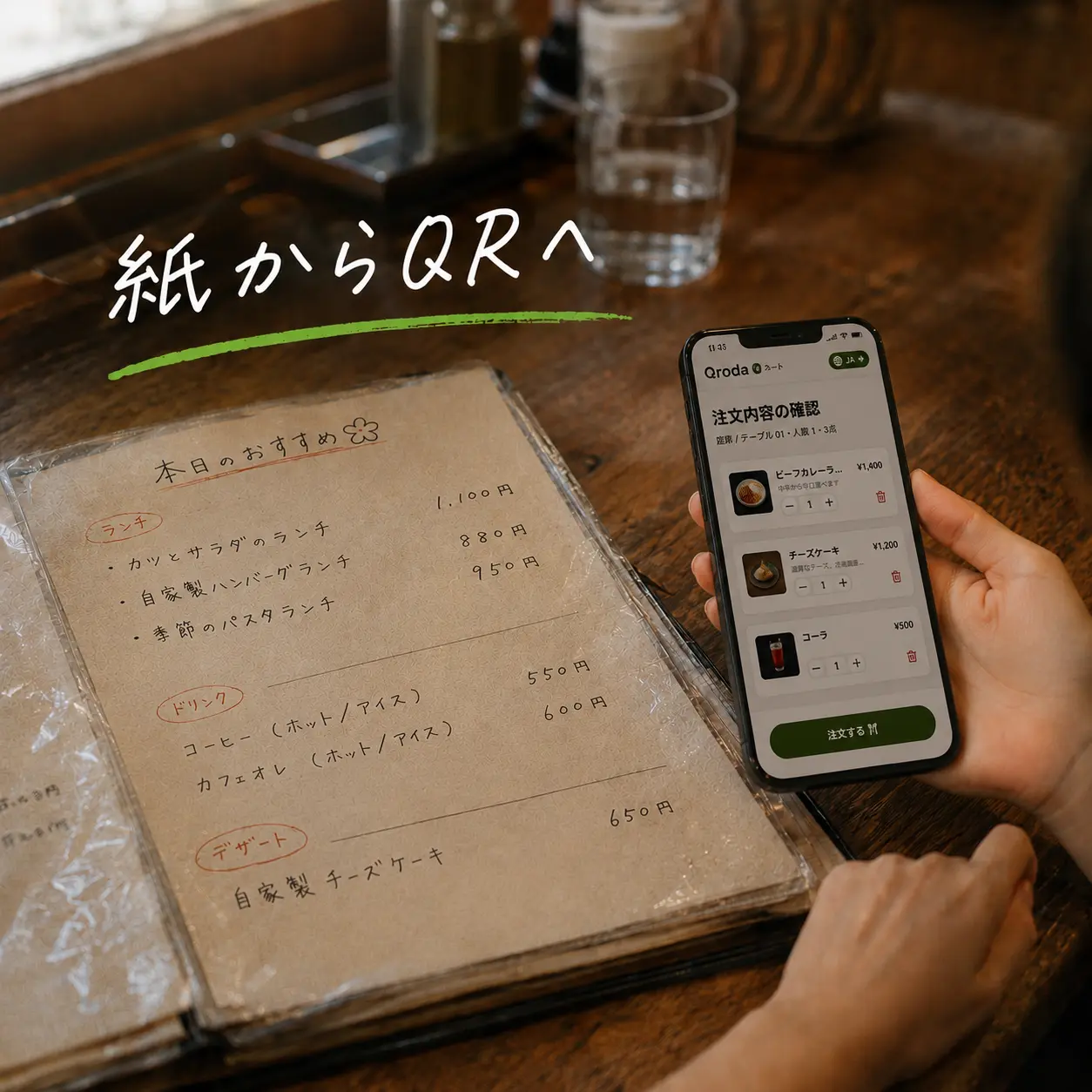
Updating photographs on a printed menu can require several steps:
- Photograph the dish.
- Edit the menu design.
- prepare new print files.
- Order replacement menus or inserts.
- Replace outdated copies.
- Dispose of or store the previous versions.
Because this process takes time and creates cost, printed photographs may remain in use even after a dish has changed.
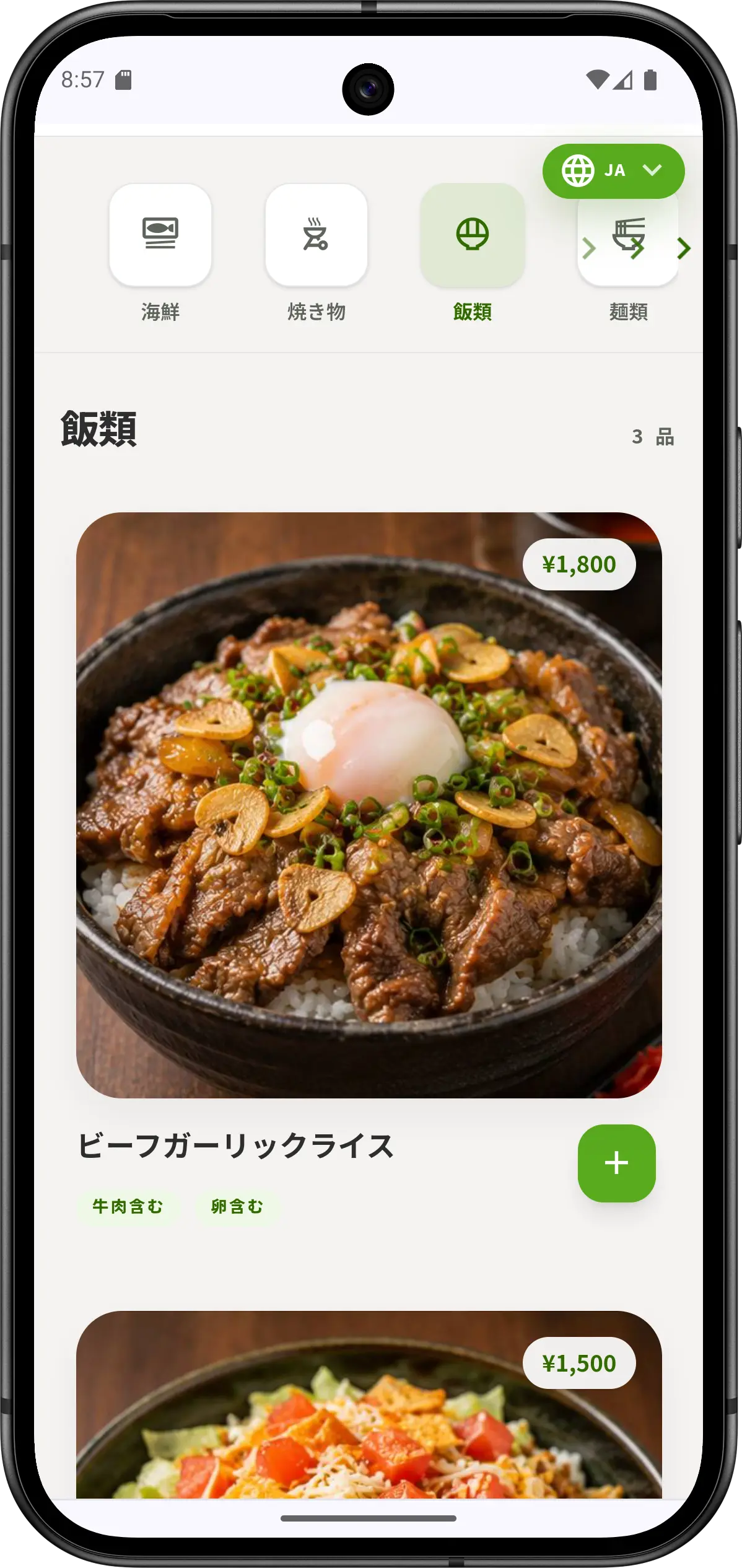
With Qroda, restaurants can add or update menu images through the digital menu interface using a compatible smartphone or computer.
This can support situations such as:
- Introducing a new lunch item
- Adding a seasonal dish
- Promoting a selected product
- Updating a photograph after the presentation changes
- Changing a price or description
- Marking an item as unavailable
- Hiding a sold-out product
Digital updates can reduce printing work and allow the menu to reflect current operations more closely.
However, updates should still follow a basic review process. Staff should confirm that:
- The photograph represents the current product
- The price is correct
- The description is accurate
- Required allergen or dietary information is included
- The item is routed to the correct operational workflow
- Availability is updated consistently
Small Menu Improvements Can Create Operational Capacity
Increasing lunch profitability does not always require a price increase.
Restaurants can also examine whether the menu creates unnecessary delay or confusion.
Potential improvements include:
- Reducing uncertainty during menu selection
- Reducing repetitive staff explanations
- Making signature products easier to identify
- Communicating portion and presentation more clearly
- Directing appropriate attention to high-contribution items
- Updating unavailable products promptly
- Improving the flow from selection to order submission
A menu with photographs is not simply a visual upgrade.
When designed accurately, it can help customers understand products, compare relevant choices, and order with greater confidence.
The commercial impact should not be assumed.
Restaurants should measure it.
Useful metrics include:
- Median time from seating to order submission
- Questions asked before ordering
- Sales mix by menu item
- Contribution margin by item
- Average transaction value
- Additional-order rate
- Order corrections and remakes
- Total table occupancy
- Customer feedback
- Lunch-period customer capacity
A simple comparison before and after selected photographs are introduced can show whether the change is improving decision speed, menu mix, or service efficiency.
Qroda provides QR menu and order-management features designed for smaller restaurants.
It allows operators to display menu photographs, update product information, manage availability, and receive customer orders through a digital interface.
The purpose is not to pressure customers into making faster decisions.
It is to provide enough accurate information for customers to choose confidently while reducing avoidable work during busy service periods.
Evidence Base
- Experimental research found that adding pictures to commonly described food items can improve customer attitudes, willingness to pay, and purchase intentions. The effect varies according to menu wording and how customers process information.
- A meta-analysis found that menu design has stronger effects on attention, attitudes, and intentions than on actual purchasing behavior. This supports avoiding claims that photography automatically increases sales.
- Research into digital menus indicates that images and other presentation formats can influence perceptions of information, food, and service quality, which may affect behavioral intentions.
- Restaurant choice-overload research suggests that perceived option volume and time pressure can increase decision difficulty, but the effect varies according to the customer’s goals and dining context.

