
How Short-Staffed Restaurants Maintain Service by Reducing Order-Handling Work
“We do not have enough staff.”
This remains a common concern across the restaurant industry.
Depending on the market, operators may struggle to attract applicants, retain experienced employees, cover peak periods, or manage seasonal demand. Even where the labor market has stabilized, restaurant recruitment and retention continue to be significant operational challenges.
The problem is not limited to the number of employees on the schedule.
The more immediate problem is often that food production and customer service are interrupted by repeated order-handling tasks.
A staff member seats a customer, explains the menu, takes the order, confirms modifications, communicates the order to the kitchen, returns for additional items, answers questions, and processes payment. At the same time, other tables need attention and new customers may be arriving.
The team may be moving constantly while customers still experience the service as slow.
This is a common operational problem in small and medium-sized restaurants: limited staff capacity is consumed by repeated movement, communication, and data entry.
Recruitment Alone Is Not a Complete Solution
Hiring additional employees may be appropriate when demand and revenue support it.
People remain central to hospitality. Staff members create value by explaining food, understanding unusual requests, resolving problems, recognizing returning customers, and responding to situations that require judgment.
However, relying only on recruitment to solve every capacity problem creates risk.
Labor conditions differ by country and region. Wage levels, payroll costs, immigration rules, employee availability, working-hour regulations, seasonal demand, tipping practices, and training requirements all influence how easily a restaurant can expand its team.
Restaurants also face pressure from food, energy, occupancy, insurance, and payment costs. Their ability to recover those increases through higher menu prices depends on customer purchasing power, local competition, and market positioning.
The objective should therefore not be to remove employees.
It should be to reduce work that does not need to be performed manually every time.
Order Handling Is a Process That Can Be Simplified
Restaurant work can be divided into two broad categories:
- Tasks where human skill and judgment create substantial value
- Repetitive tasks that can be standardized, simplified, or automated
High-value human activities include:
- Preparing and presenting food
- Monitoring the dining room
- Supporting customers who need assistance
- Explaining complex dishes or ingredients
- Managing service recovery
- Maintaining cleanliness and quality
- Coordinating the kitchen and front of house
Routine order-handling activities may include:
- Repeatedly walking to a table to collect an order
- Writing or memorizing order details
- Entering an order into another system
- Communicating standard orders to the kitchen
- Explaining the same menu information repeatedly
- Notifying each table about unavailable products
- Updating printed prices and descriptions
- Returning only to collect an additional order
These tasks become particularly disruptive during peak periods.
A customer calls a staff member. The employee walks to the table, listens to the order, confirms the details, and then returns to the service station or kitchen. While this is happening, another table wants an additional item, a new party enters, and a payment request is waiting.
When this cycle is repeated, the front-of-house team is forced into a reactive operating pattern.
Allowing customers to submit standard orders through their own smartphones can reduce some of this movement and manual order capture.
The value does not come from technology alone. It comes from redesigning the process so that staff members spend less time carrying information between the customer, service station, and kitchen.
QR Ordering Should Support Staff, Not Replace Them
QR ordering should not be treated primarily as a staff-reduction tool.
Its more practical purpose is to help a limited team maintain service quality by reducing routine order-handling work.
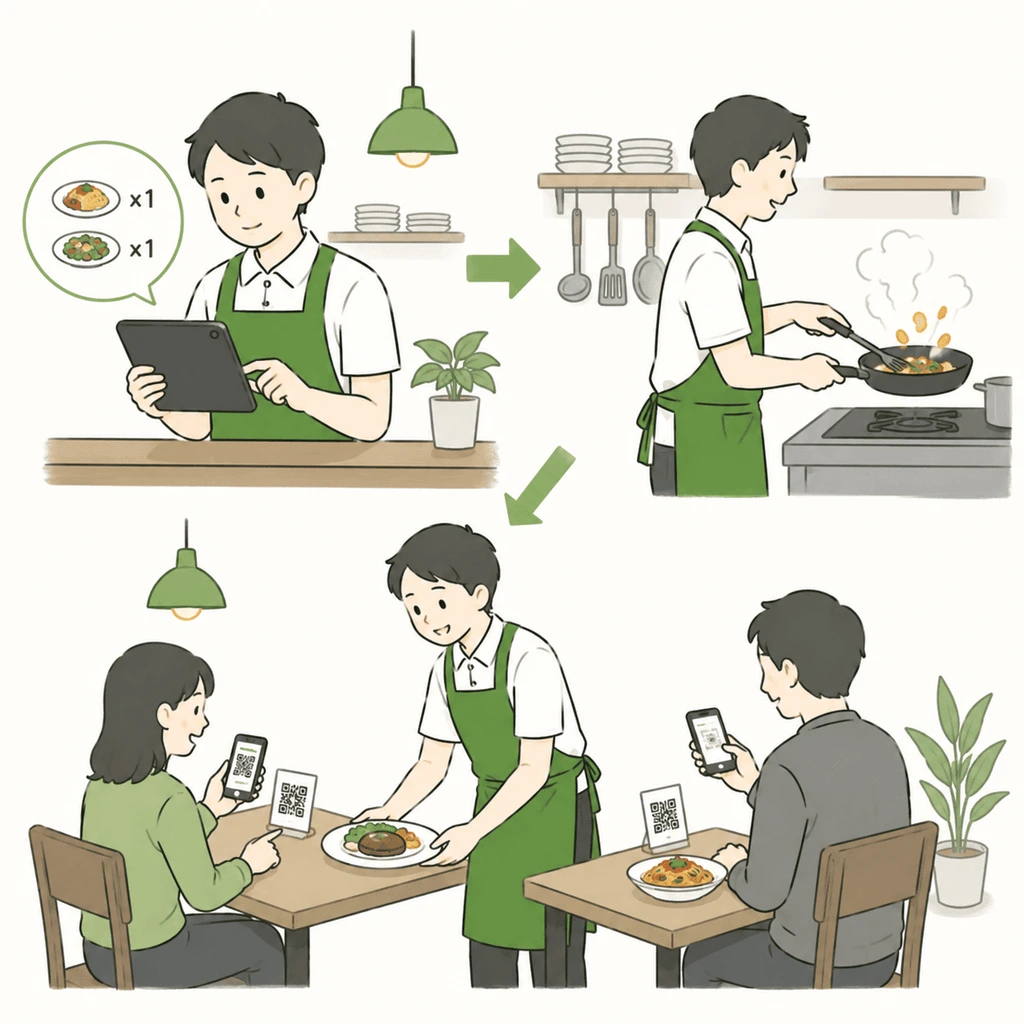
A typical process may operate as follows:
- The customer scans a QR code at the table.
- The customer reviews the current menu on a smartphone.
- The customer submits an order.
- The order appears in the restaurant’s order-management interface.
- Staff confirm and process it through the appropriate kitchen or service workflow.
This process may reduce the need to:
- Walk to every table to collect a standard order
- Re-enter handwritten order details
- Clarify information that can be displayed in the menu
- Communicate routine orders manually
- Explain unavailable products repeatedly
However, these benefits depend on correct implementation.
A QR system will not improve operations when:
- The menu is difficult to navigate
- The interface is slow or unreliable
- Orders do not reach the correct team
- Staff responsibilities are unclear
- Customers cannot request assistance
- The restaurant offers no alternative for customers who cannot or do not want to use a smartphone
- The ordering system is not integrated with the kitchen workflow
The restaurant should therefore retain a clear human-support option.
Digital ordering should reduce avoidable work without creating a barrier for customers who prefer personal service or require assistance.
Return staff time to the work where human attention has the greatest value.
That is the operational purpose of QR ordering.
Customer Acceptance Depends on Context
Self-service ordering, mobile ordering, touchscreens, and digital payment have become familiar in many markets and restaurant formats.
Industry research indicates that customers often value restaurant technology that makes ordering and payment faster or easier. However, preferences vary by age, market, service style, occasion, accessibility needs, and customer expectations.
For some customers, smartphone ordering offers practical advantages:
- They do not need to attract a staff member’s attention
- They can review the menu at their own pace
- They can submit additional orders when ready
- They can review written item names and selections before submitting
- They may have easier access to language, ingredient, or allergen information
For the restaurant, structured digital order capture may reduce some communication errors and missed orders. For the customer, it may reduce unnecessary waiting.
These outcomes are not automatic.
The experience depends on accurate menu data, clear design, dependable connectivity, accessible alternatives, and responsive staff support.
QR ordering should therefore be introduced as one service channel within a complete customer experience, not as an instruction for customers to manage the service themselves.
Smaller Restaurants May See a Greater Operational Effect
QR ordering is not limited to large restaurant groups.
It can be particularly relevant to smaller operations because one employee often performs several roles.
Consider a restaurant where the owner works in the kitchen while one employee manages the dining room. Each time the owner or employee stops to collect an order, another activity may be delayed.
With several occupied tables, the following tasks can quickly overlap:
- Order taking
- Food preparation
- Food delivery
- Table clearing
- Customer questions
- Additional orders
- Payment processing
Reducing routine order-taking may allow the owner to maintain greater continuity in food preparation and allow the front-of-house employee to focus on delivery, cleaning, and customer support.
The strongest use case is often not a restaurant that needs several fewer employees.
It is a restaurant that operates adequately during normal periods but becomes overloaded during short demand peaks.
“We do not need another full shift, but service becomes difficult during the busiest hour.”
For this type of operation, simplifying order handling may be more practical than adding permanent staffing capacity that is only required for limited periods.
Starting QR Ordering and Order Management with Qroda
Qroda is a QR ordering and digital menu system designed for restaurants and other small service businesses.
Customers scan a table QR code, review the menu on their smartphones, and submit orders through the digital interface.
The restaurant receives the orders through an order-management dashboard.
Key functions include:
Menu Management from a Smartphone or Computer
Product names, descriptions, prices, availability, and display status can be updated without reprinting the physical menu.
Table-Specific QR Codes
Orders can be associated with the table from which they were submitted, helping staff identify the correct service location.
Real-Time Order Dashboard
Incoming orders can be viewed in one interface, reducing the need to rely on verbal communication or separate handwritten notes.
Multilingual Menu Support
Restaurants can make menu information available in multiple languages, potentially reducing the amount of routine explanation required from staff.
Qroda does not require customers to use dedicated restaurant-owned ordering terminals.
The restaurant can manage the system through compatible existing devices, while customers use their own smartphones.
Before implementation, operators should still assess:
- Device and browser compatibility
- Network reliability
- Kitchen and front-of-house workflows
- Payment integration requirements
- Data protection obligations
- Accessibility
- Staff training
- Support for customers who do not use QR ordering
The objective is not simply to install software.
It is to create a reliable order flow from the customer to the team responsible for preparing and delivering the order.
Reducing Staff Movement Is a Practical Capacity Strategy
In a short-staffed restaurant, unnecessary movement consumes limited capacity.
A typical employee may repeatedly:
- Walk to a table
- Return to the service station
- Confirm an order
- Revisit the table
- Explain an unavailable item
- Return to process payment
The longer and less predictable this workflow becomes, the greater the risk of fatigue, delay, and error.
Errors then create additional work through corrections, remakes, refunds, and customer complaints.
The first step should therefore be to identify repetitive movements and information transfers that occur with nearly every order.
A well-designed order-management process can centralize incoming information and clarify what needs to be prepared, delivered, updated, or confirmed.
This can make the overall service environment more controlled.
Technology is most effective when it simplifies the workflow rather than merely adding another interface. OECD research identifies reduced operating and transaction costs, automation, and productivity improvement as potential benefits of SME digitalisation, while also emphasizing the importance of integrating digital tools into core business processes.
Busy Does Not Necessarily Mean Profitable
A restaurant can appear busy while still losing revenue and margin through inefficient operations.
Examples include:
- Staff cannot collect all intended orders
- Additional drink or dessert orders are missed
- Food delivery is delayed
- Customer satisfaction falls
- Employees become exhausted and leave
- Order errors create waste or refunds
- Menu updates require excessive administrative work
- Management has little time to review performance
In this situation, customer demand exists, but the operating system prevents the restaurant from converting that demand efficiently.
A better order process may help a limited team manage service more consistently.
Staff can work with clearer priorities, customers can place standard orders when ready, and owners can devote more attention to food quality, customer support, and business management.
A restaurant that is resilient under staffing pressure is not necessarily the restaurant with the largest team.
It is the restaurant that uses its available team for the work where people create the most value.
Begin by Reviewing Order-Handling Work
There is no single system that can solve every restaurant staffing problem.
However, order handling is a practical place to begin because it occurs throughout every service period.
The restaurant does not need to eliminate employees or remove personal service.
It needs to identify activities that do not require the same manual effort for every customer and every order.
Qroda provides QR menu and order-management functions that may be suitable for smaller restaurants seeking to simplify order confirmation and information sharing during busy periods.
The appropriate goal is not complete automation.
It is a more balanced operating model in which staff can concentrate on:
- Food preparation
- Quality control
- Customer assistance
- Service recovery
- Cleanliness
- Delivery
- Overall restaurant management
When staffing capacity is limited, the first operational question should not always be, “How can we hire more people?”
It should also be:
“Which repetitive tasks can we remove from the team’s workload?”
For many restaurants, reviewing the order-handling process is a practical first step.
Evidence Base
- The National Restaurant Association reports that recruitment, retention, training, scheduling, and manager effectiveness remain important workforce issues for restaurant operators. Its research also emphasizes the role of supportive technology rather than treating technology primarily as a substitute for permanent employees.
- Restaurant technology research indicates that customers tend to value tools that make ordering and payment easier and faster, although acceptance varies by service format and customer group.
- OECD research finds that SME digitalisation can reduce transaction and operating costs, support automation, and improve productivity when digital tools are integrated into core operations.
- International Labour Organization material shows that hospitality working conditions and labor constraints differ substantially by market, including differences in working hours, wages, social protection, informality, and regulation. This supports avoiding a single country-specific staffing assumption.

