

Excessive Labor Cost Cutting Can Gradually Undermine Restaurant Service
Labor is one of the largest operating costs for many restaurants.
When revenue is below expectations or margins are under pressure, reviewing staffing expenses is a reasonable management response.
Operators may consider:
- Reducing scheduled hours
- Adjusting staffing by demand period
- Removing unnecessary overtime
- Combining roles
- Using flexible or seasonal staffing
- Improving labor scheduling
These measures can improve productivity when they are based on reliable demand data and a clear operating model.
However, labor reduction has limits.
When staffing falls below the level required to deliver the restaurant’s service model, hidden operational pressure begins to accumulate.
Orders take longer to collect. Food waits before being delivered. Tables are not cleared promptly. Staff have less time to monitor customers. Questions and payment requests are delayed. Employees appear rushed or unavailable.
Each issue may initially seem minor.
Over time, however, these small service failures can change how customers evaluate the restaurant.
Customers may feel that:
- The restaurant is less organized than before
- Service has become slower
- Employees are too busy to approach
- Quality varies between visits
- Ordering or payment requires too much effort
Customers do not always report these concerns directly.
Some simply select another restaurant the next time they dine out.
This makes excessive labor reduction difficult to detect. Payroll costs fall immediately, while the effects on repeat visits, reviews, staff turnover, errors, and sales may appear gradually.
1. Labor Cost Should Be Balanced Against Service Capacity
Labor should not be managed only as a percentage of sales.
A low labor percentage is not automatically a sign of an efficient restaurant.
It may indicate that:
- Employees are handling unsustainable workloads
- Managers are covering excessive operational shifts
- Tables are waiting too long
- Sales opportunities are being missed
- Cleaning and preparation work is being delayed
- Training is being neglected
- Service quality depends on employees working beyond scheduled hours
The correct staffing level depends on the restaurant’s format and service promise.
A counter-service business, a full-service restaurant, a café, and a fine-dining operation require different labor structures. Local wage laws, payroll taxes, benefits, tipping practices, working-time rules, and customer expectations also vary substantially between markets.
Operators should therefore evaluate the fully loaded cost and productive value of labor, rather than relying on one universal staffing ratio.
Relevant costs may include:
- Wages and salaries
- Employer taxes and statutory contributions
- Benefits and paid leave
- Overtime
- Recruitment
- Training
- Uniforms and equipment
- Scheduling and management time
- Turnover and replacement costs
Relevant operational outcomes may include:
- Sales per labor hour
- Orders processed per hour
- Customer waiting time
- Order accuracy
- Food delivery time
- Table-reset time
- Customer complaints
- Employee absence
- Staff turnover
- Manager overtime
The objective is not to minimize labor at any cost.
It is to maintain sufficient capacity while removing work that does not create proportional value.
2. Employees Evaluate the Complete Working Environment
Compensation remains important, but it is not the only factor that affects recruitment and retention.
Employees also evaluate:
- Workload
- Scheduling predictability
- Working hours
- Training
- Management quality
- Fair treatment
- Safety
- Role clarity
- Access to appropriate tools
- Opportunities to develop
- The level of support available during busy periods
The hospitality sector faces different labor conditions across countries, but international evidence identifies recurring concerns such as variable or long working hours, limited social protection in some markets, weak occupational safeguards, seasonality, and uneven access to training.
A restaurant that repeatedly operates below a sustainable staffing level may create:
- Constant time pressure
- More order and payment errors
- Conflict between employees
- Inconsistent customer interactions
- Higher physical and mental fatigue
- Lower willingness to accept additional shifts
- Increased employee turnover
This does not mean that every difficult shift will cause employees to leave.
Restaurant work naturally includes periods of high demand.
The problem arises when exceptional pressure becomes the normal operating model.
Employees are more likely to perform consistently when they understand the workflow, know their responsibilities, receive adequate training, and have systems that reduce avoidable confusion.
Focusing only on payroll can hide the operational cost transferred to employees.
Public comments from current or former staff may also affect an employer’s reputation. However, operators should not design workplace policy solely around the risk of negative online posts.
The stronger business reason is that a stable, well-supported team is generally better positioned to deliver consistent service.
3. Recruitment Does Not Correct a Poor Process
When a restaurant is short-staffed, recruitment is an obvious response.
However, hiring alone may not resolve the underlying problem.
New employees require:
- Recruitment time
- Interviews
- Administration
- Onboarding
- Menu and product training
- Supervised shifts
- Feedback
- Time to understand the service model
Even a capable new employee will initially have less knowledge of the restaurant’s menu, regular customers, kitchen workflow, and service expectations.
Temporary or on-demand staff may provide useful short-term capacity. Their effectiveness depends on the role, training requirements, shift complexity, and quality of operating documentation.
Potential limitations include:
- Limited menu knowledge
- Less familiarity with restaurant procedures
- Slower decisions during unusual situations
- Less awareness of regular-customer preferences
- Greater need for supervision
- Inconsistent execution between shifts
Temporary staffing is not inherently inferior. It can work well when tasks are clearly defined and training is efficient.
The larger issue is that additional people cannot fully compensate for a process that is confusing, repetitive, or poorly designed.
If every employee must repeatedly search for information, clarify sold-out items, re-enter orders, or ask a manager how to handle routine situations, adding more staff may increase coordination work without solving the core constraint.
Restaurants should review the workflow before assuming that every capacity problem requires another employee.
4. Excessive Workload Weakens the Operation
Restaurant operators must control labor costs to protect margins.
Employees require a working environment in which the expected workload can be completed safely and consistently.
These priorities do not need to conflict.
The practical approach is to identify work that consumes staff time without requiring human judgment on every occasion.
Examples include:
- Walking to collect every routine order
- Writing down information that must later be entered again
- Confirming misheard order details
- Repeating standard menu explanations
- Informing each customer separately about unavailable items
- Checking order totals manually before payment
- Updating the same product information in several places
- Transferring routine information verbally between teams
These activities consume both time and attention.
They can also interrupt higher-value work such as:
- Monitoring food quality
- Supporting customers with specific needs
- Delivering food promptly
- Resolving service problems
- Maintaining cleanliness
- Coordinating kitchen and dining-room activity
- Creating a welcoming atmosphere
Personal service remains an important part of hospitality.
The operational question is not whether service should be automated completely.
It is whether every routine information exchange needs to be performed manually.
5. Smaller Restaurants Can Adopt Digital Tools Selectively
Digital transformation does not require a small restaurant to replace its entire operating system.
Large, complex implementations may create unnecessary cost and disruption when the business only needs to improve one part of its workflow.
Smaller businesses can take a more selective approach:
- Identify the recurring operational constraint.
- Measure how much time or capacity it consumes.
- Select a limited tool that addresses that problem.
- Test it in a controlled part of the operation.
- Review the effect on staff and customers.
- Expand only when the results justify it.
OECD research finds that digitalisation can help smaller businesses reduce transaction and operating costs, automate routine processes, and release time for more valuable activities. It also notes that benefits depend on integrating technology into the actual workflow rather than simply adding another disconnected tool.
For many restaurants, order handling is a practical starting point.
It occurs repeatedly during every service and can create significant pressure during peak demand.
A traditional order process may require an employee to:
- Notice that a customer is ready.
- Walk to the table.
- Listen to the order.
- Confirm options and modifications.
- Record the information.
- Enter or communicate it to the kitchen.
- Return later for additional orders.
- Resolve any misunderstanding.
A QR ordering system can allow customers to review available items and submit standard orders from their smartphones.
This may reduce some manual order-taking and repeated movement.
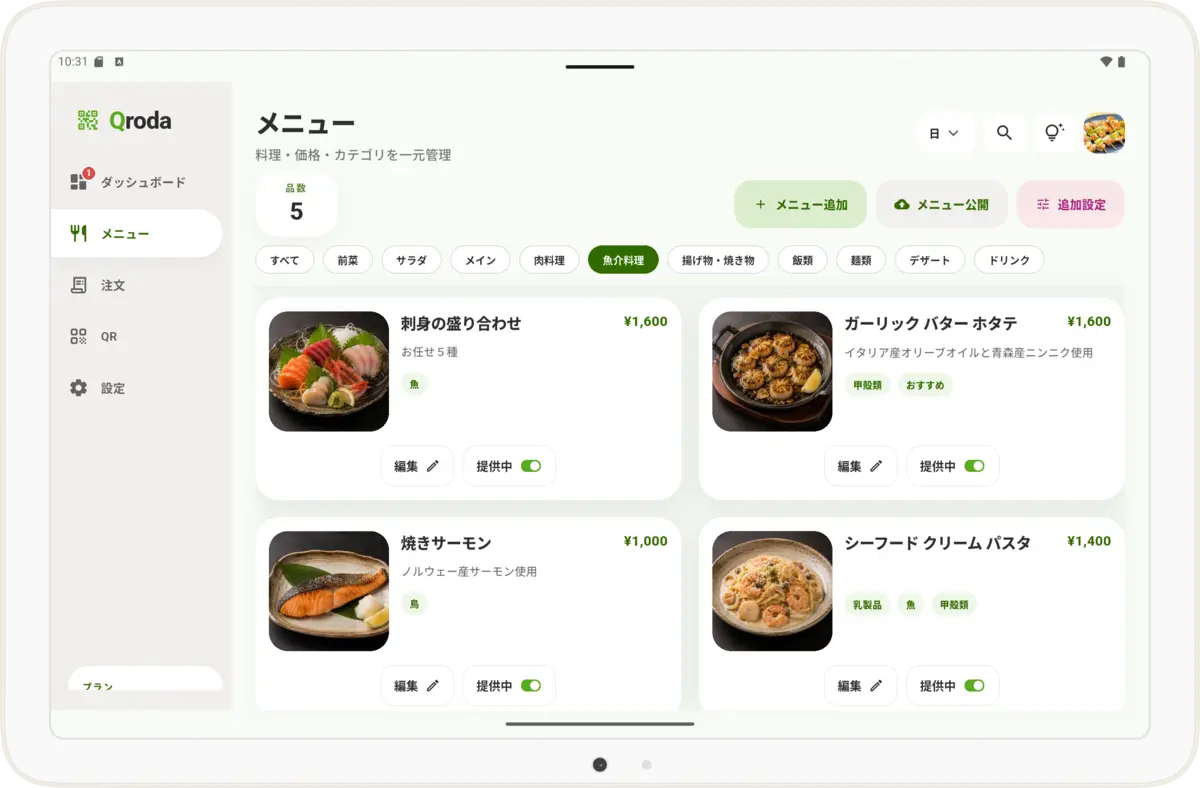
The staff can then devote more attention to:
- Delivering food
- Supporting customers who need assistance
- Monitoring the dining room
- Clearing tables
- Confirming exceptional requests
- Managing service recovery
This is a targeted form of operational digitalisation.
Its purpose is not to remove labor indiscriminately. It is to improve how existing labor capacity is used.
6. QR Ordering Must Be Designed Around the Service Model
QR ordering is not appropriate in exactly the same form for every restaurant.
Customer preferences differ according to market, age, accessibility needs, dining occasion, restaurant format, and familiarity with digital services.
A suitable implementation should include:
- A clear explanation of how to order
- A menu that works effectively on common smartphones
- Accurate product names, prices, and availability
- Clear allergen and dietary information where required
- A simple method for requesting staff assistance
- A non-digital alternative when necessary
- Defined responsibility for monitoring incoming orders
- Reliable communication with the kitchen
- Staff training and fallback procedures
- Appropriate data and privacy controls
The system should not make customers feel that the restaurant has transferred all service responsibility to them.
It should remove unnecessary waiting while keeping human help available.
A poorly designed system may create new problems:
- Customers cannot connect
- The menu is difficult to navigate
- Orders are submitted to the wrong table
- Staff fail to notice new orders
- Modifications are unclear
- Customers do not know whether the order was accepted
- Employees must operate parallel systems
Technology creates value only when the full workflow is simpler after implementation.
7. Measure the Cost of Understaffing, Not Only Payroll Savings
Before reducing another shift or removing another employee, operators should consider the costs that may appear elsewhere.
These may include:
- Missed orders
- Fewer additional drink or dessert purchases
- Longer table occupancy
- More refunds, voids, or remakes
- Reduced customer satisfaction
- Higher employee absence
- Increased turnover
- Additional recruitment and training
- Manager burnout
- Reduced opening hours
- Lower consistency between service periods
Labor decisions should therefore be evaluated through total operating performance.
A useful review could compare:
| Area | Possible measure |
|---|---|
| Productivity | Sales or contribution margin per labor hour |
| Customer service | Time to acknowledgement, order, delivery, and payment |
| Quality | Errors, remakes, refunds, and complaints |
| Capacity | Customers served and orders completed during peak periods |
| Workforce | Absence, overtime, turnover, and training time |
| Commercial performance | Average transaction value and additional-order rate |
A reduction in payroll is beneficial only when it does not create a larger loss elsewhere.
Small Operational Changes Can Restore Capacity
Qroda is a QR ordering service designed for restaurant order management.
Rather than replacing the restaurant’s entire technology stack, it focuses on the ordering process.
Customers can review the menu and submit orders from their smartphones, while the restaurant monitors incoming orders through an order-management interface.
Depending on the plan and implementation, a restaurant may be able to begin without purchasing dedicated ordering terminals for every table. Current pricing, setup requirements, device compatibility, and contract terms should be confirmed directly before adoption.
The relevant business case is not:
“How many employees can this system replace?”
It is:
“How much repetitive work can this system remove from the current team?”
Restaurants considering QR ordering should assess whether it can help them:
- Reduce routine trips to collect orders
- Update prices and availability more quickly
- Reduce duplicated order entry
- Make information easier for customers to review
- Support additional orders during busy periods
- Improve coordination between the dining room and kitchen
- Preserve staff attention for customer care
The strongest operating model is not necessarily the one with the lowest possible payroll.
It is the one that delivers the required customer experience with a sustainable workload and a commercially viable cost structure.
Before reducing labor further, restaurant operators should review the tasks employees perform repeatedly and determine which can be simplified, standardized, or handled through an appropriate system.
The purpose is not to mechanize hospitality.
It is to protect the time and attention required to deliver it.
Evidence Base
- The International Labour Organization identifies recurring working-condition challenges in tourism and food-and-beverage services, including variable or long working hours, informality in some markets, limited social protection, and occupational safety concerns. Conditions differ substantially by country and region.
- OECD research finds that digitalisation can help SMEs improve productivity, reduce operating and transaction costs, and automate routine work. It also emphasizes that technology must be integrated into business processes to deliver these benefits.
- Restaurant workforce research indicates that operators use technology to support recruitment, scheduling, training, engagement, and operating performance. Recent findings also indicate that most surveyed technology investments did not eliminate permanent restaurant jobs, supporting a workforce-assistance rather than workforce-replacement framing.

