How Small Restaurants Can Protect Profit: Why an Official Website and a Better Ordering Experience Matter
Running a small restaurant remains financially demanding.
Labor costs, food prices, rent, energy, insurance, payment-processing fees, and other operating expenses continue to place pressure on restaurant margins. In one recent industry study, food, beverage, and labor costs accounted for a substantial share of restaurant revenue, while pre-tax margins remained narrow. Although the figures vary by country and restaurant type, the operating principle is consistent: small changes in cost, productivity, or sales conversion can have a significant effect on profit.
Restaurants cannot always raise prices enough to offset every increase in operating costs. Customer purchasing power, local competition, tax structures, tipping practices, and market positioning all affect how much pricing flexibility an operator has.
In this environment, protecting revenue does not necessarily mean adding more tasks.
It means focusing on the activities that have the greatest commercial impact.
For many small restaurants, two areas deserve immediate attention:
- The official website and pre-visit customer journey
- The ordering experience after the customer arrives
When these two elements work together, the restaurant can improve customer confidence, reduce lost sales, and use staff time more effectively.
1. Build an Official Digital Presence You Control
A small restaurant does not need an expensive or visually complex website.
It does not need elaborate animation, hundreds of photographs, or a detailed page for every menu item.
It needs a reliable source of official information.
At a minimum, the website should present:
- The restaurant’s name and concept
- Location and current opening hours
- The type of food or service offered
- A representative view of the atmosphere
- Signature or high-priority menu items
- Typical pricing
- Reservation and enquiry methods
- Dietary, accessibility, or service information where relevant
This information should ideally be published through a domain and website that the restaurant controls.
Customers often discover restaurants through search engines, maps, review platforms, social networks, delivery services, and local directories. These third-party platforms provide valuable visibility, but the restaurant does not control their algorithms, advertising formats, listing rules, or competitor placement.
A third-party profile is therefore an important discovery channel, but it should not be the restaurant’s only source of information.
An official website gives the business a stable location where customers can confirm accurate details without being immediately redirected to competing restaurants.
The purpose is not simply to make the restaurant appear more sophisticated.
The purpose is to create a trusted source of information when someone searches for the business by name or looks for a restaurant in the area.
OECD research notes that digitalisation can help small and medium-sized businesses increase market reach, reduce transaction costs, improve productivity, and compete more effectively. However, these benefits depend on integrating digital tools into core business operations rather than treating them as isolated promotional channels.
2. Design for Confidence, Not Information Volume
More website content does not automatically produce better results.
A restaurant website should answer the customer’s main questions quickly:
- What kind of restaurant is this?
- What can I order?
- What is the expected price range?
- Where is it?
- When is it open?
- How do I reserve or contact the restaurant?
- Is it appropriate for my needs?
A small number of strong, accurate photographs may be more useful than a large gallery of inconsistent images.
The most useful photographs usually show:
- A signature dish
- The dining environment
- The approximate portion or presentation style
- The entrance or exterior, when it may be difficult to locate
Publishing too much unstructured information can make the restaurant’s concept less clear and increase the time customers need to make a decision.
The website should therefore function as a practical decision-making tool, not simply as a storage location for content.
Review platforms remain commercially important, but a restaurant should not direct all of its attention toward improving a single public rating.
Recommendations from friends, family members, colleagues, local communities, and trusted creators can also influence restaurant selection. These recommendations are usually generated by a memorable experience rather than by promotional activity alone.
Customers are more likely to recommend a restaurant when they can clearly describe what made it worth visiting:
- A distinctive menu item
- A comfortable atmosphere
- Helpful service
- Good value
- A simple booking process
- An easy ordering experience
- Consistent quality
For a small restaurant, creating an experience that customers can easily describe and recommend may be more valuable than constantly producing promotional content.
3. The Customer Experience Begins Before the Food Arrives
Attracting customers is only the first stage.
Once a customer enters the restaurant, the evaluation of the experience begins immediately.
Before the first dish arrives, the customer may already be assessing:
- Whether the table is clean
- Whether the menu is easy to understand
- Whether prices and additional charges are clear
- Whether staff acknowledge their arrival
- Whether ordering instructions are obvious
- Whether the expected waiting time is reasonable
- Whether assistance is available when required
A customer may be satisfied with the food but still leave with a negative impression if the ordering process is confusing or unnecessarily slow.
Common problems include:
- Customers do not know how to place an order
- Staff are too busy to notice a table
- The menu is difficult to read
- Recommendations are unclear
- Unavailable items are still displayed
- Customers cannot easily request an additional order
- Charges or service conditions are not explained clearly
These points create friction before the restaurant has had an opportunity to demonstrate the quality of its food.
Operators should therefore review the complete process from seating to order confirmation.
The objective is to make the next step obvious at every stage.
4. When Staffing Is Limited, Reduce Order-Handling Work
Small restaurants cannot always add employees during busy periods.
Recruitment may be difficult, labor may be expensive, or demand may not be predictable enough to justify additional permanent staffing.
The restaurant must therefore find ways to manage peak demand with the available team.
Relying on employees to work faster has clear limits.
A more sustainable approach is to reduce repetitive order-handling tasks through better processes and appropriate technology.
Potential improvements include:
- Reducing repeated trips to take orders
- Reducing manual order entry
- Preventing misheard or incorrectly communicated orders
- Updating sold-out items immediately
- Making allergen or product information easier to access
- Allowing customers to place additional orders without waiting
- Sending confirmed orders directly to the appropriate workflow
- Reducing repeated explanations of standard menu options
This does not mean eliminating human service.
It means separating tasks that require human judgment from tasks that can be standardized.
Staff members create the greatest value when they are:
- Delivering food promptly
- Monitoring customer needs
- Resolving unusual requests
- Explaining complex menu items
- Maintaining quality and cleanliness
- Supporting customers who prefer personal assistance
- Coordinating the dining room and kitchen
A digital ordering system can reduce routine work while allowing staff to provide personal service when it matters.
5. Ordering Convenience Can Influence Repeat Visits
Customers compare the complete experience, not only the food.
When nearby restaurants offer similar quality and pricing, small operational differences may affect which business a customer chooses to revisit.
A customer may remember that:
- Ordering was straightforward
- The menu was easy to understand
- Additional items could be ordered without waiting
- Staff were available when assistance was needed
- Unavailable products were clearly marked
- Payment was simple
- The overall experience required little effort
These details reduce customer friction.
A smoother ordering process may also reduce missed revenue opportunities.
For example, a customer may decide not to order an additional drink or dessert if it is difficult to attract a staff member. Allowing the customer to view available products and order at the appropriate moment may increase the probability that the additional purchase is completed.
This does not mean that digital ordering automatically increases repeat visits or average transaction value.
Results depend on menu design, customer demographics, service format, staff training, technology reliability, and how well the system is integrated into the overall experience.
The broader principle is that unnecessary effort can reduce both customer satisfaction and sales conversion.
Use the Official Website to Build Trust and Qroda to Reduce Lost Orders
The customer journey for a small restaurant can be divided into two connected stages.
Before the visit: the official website
The website communicates the restaurant’s identity, location, atmosphere, menu direction, pricing, and service conditions.
Its role is to reduce uncertainty and help the customer decide whether the restaurant is suitable.
After arrival: the ordering experience
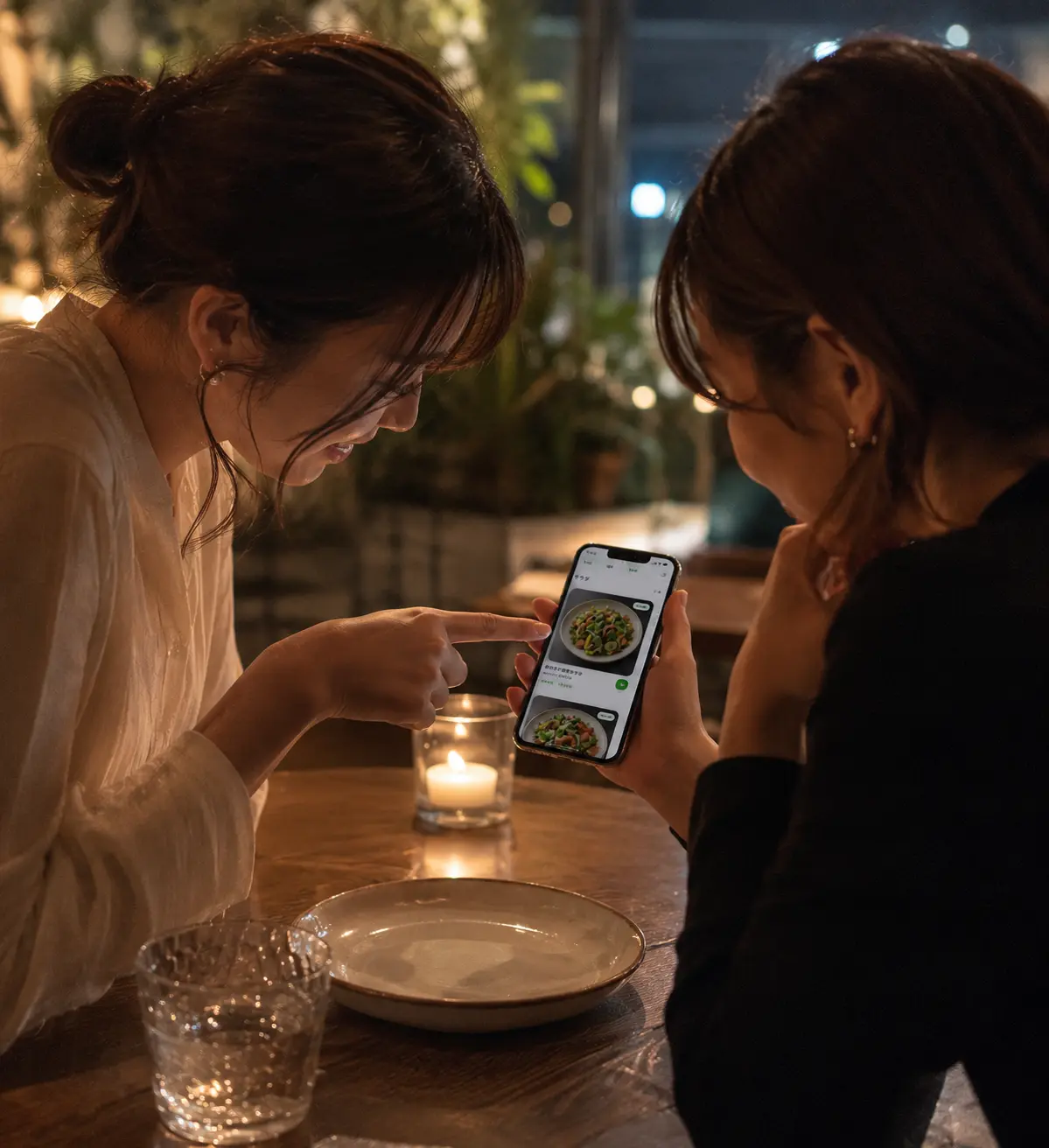
Once the customer is seated, the ordering process should make it easy to understand the menu, place an order, request additional items, and obtain assistance when required.
Qroda is designed to support this second stage through QR-based ordering and digital menu management.
It is not intended simply to make a restaurant appear technologically advanced.
It is a practical operational tool for reducing lost sales and unnecessary order-handling work after the customer has been seated.
Potential benefits include:
- Customers can order at an appropriate time without waiting for routine staff interaction
- Staff can reduce repeated trips devoted only to taking orders
- Menu changes can be published without reprinting physical menus
- Sold-out items can be updated promptly
- Additional orders can be placed more easily
- Staff can focus on food delivery, customer care, and operational quality
The objective is not to remove employees from the customer experience.
It is to use staff time where human attention creates the most value.
For small restaurants, the commercial strategy is straightforward:
- Use an official website to build trust before the visit
- Use a clear ordering process to reduce friction after arrival
- Make essential information accurate and easy to find
- Reduce repetitive tasks that consume limited staff capacity
- Create an experience that customers are willing to repeat and recommend
No single website or ordering system can guarantee profitability.
However, when labor and operating costs are high and margins are narrow, reducing customer uncertainty and operational friction can help the restaurant retain more value from the demand it already generates.
References
- OECD, The Digital Transformation of SMEs — Digitalisation can help smaller businesses improve productivity, reduce transaction costs, extend market reach, and compete more effectively.
- OECD, Supporting the Digital Transformation of SMEs — Digital channels create greater value when they are integrated into core commercial and operational processes.
- National Restaurant Association, 2026 State of the Restaurant Industry — Food, labor, insurance, energy, and payment costs remain significant concerns for restaurant operators.
- National Restaurant Association, 2025 Restaurant Operations Data Abstract — Food, beverage, and labor costs consume a substantial share of restaurant sales, while typical pre-tax margins remain limited.

