QR Ordering Encourages Small Indulgences and Increases Customer Spending
When reviewing restaurant revenue, customer numbers alone do not tell the full story.
Two restaurants may serve the same number of customers, but their revenue can differ significantly depending on average spend per customer.
Average spend is not determined only by food quality or pricing.
It is also influenced by:
- How customers view the menu
- When they can place additional orders
- How easily they can make a decision
This ordering environment can have a substantial effect on how much customers spend.
Recent international marketing research suggests that digital ordering, including QR ordering, can encourage customers to make slightly more indulgent choices and increase their overall spending.
Research Links Digital Ordering to Higher Spending
A research team involving the University of South Florida conducted a large-scale study comparing digital and face-to-face ordering.
The analysis covered more than 23,000 real orders placed across different food-service businesses.
The results showed that customers using digital ordering were more likely to choose indulgent items and spend more overall than customers ordering directly from staff.
The study reported that approximately 61% of digital orders included items associated with enjoyment or indulgence, such as desserts, fried food, richer dishes and larger portions.
The research suggests that digital ordering can make customer decisions feel more intuitive, encouraging the feeling that it is acceptable to choose something slightly more indulgent.
This has an important implication for restaurant operators.
When customers think, “I would like something extra,” or “I might treat myself today,” the restaurant needs to make it easy for them to act on that feeling.
The easier it is to place the order, the more likely that interest is to become actual revenue.
Why QR Ordering Makes Indulgent Choices Easier
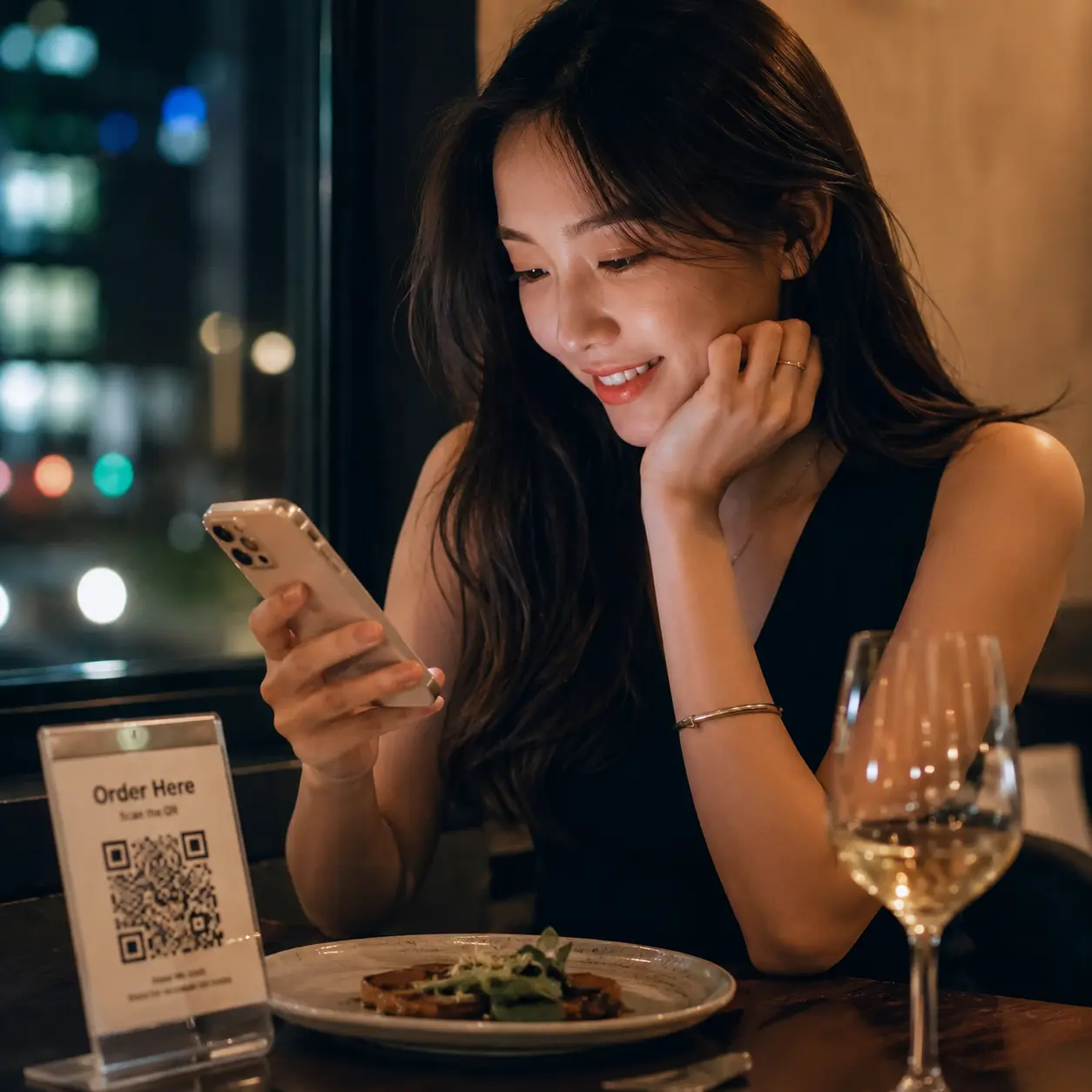
With QR ordering, customers browse the menu on their own phones.
- They do not need to call a staff member
- They do not need to decide immediately
- They can browse at their own pace without feeling watched or pressured
This lowers the psychological barrier to ordering.
That can make customers more likely to choose items such as:
- A dessert after the meal
- Another drink or alcoholic beverage
- A higher-priced recommended dish
- A rich side dish or fried item
- A seasonal or limited-time special
With face-to-face ordering, customers may decide not to place a small additional order because the staff appear busy.
With QR ordering, they can add the item directly from their table without interrupting anyone.
This small psychological shift can turn an item that would otherwise remain unordered into an actual sale.
Higher Spending Comes from Easier Choices, Not Aggressive Selling
Restaurants do not need aggressive recommendations or pressure-based upselling to increase average spend.
The more effective approach is to help customers notice items and make choices naturally.
On a printed menu, desserts, drinks and add-on dishes can become buried among large amounts of text.
During busy service periods, staff may not have time to recommend additional items to every table.
A QR menu can present products visually with photographs.
Recommended dishes, easy add-ons, drinks and desserts can be positioned where customers are more likely to notice them.
This is not aggressive selling.
It is a way to make previously overlooked items visible and make additional orders easier to place.
Over time, these small decisions can increase average customer spending.
QR Ordering Can Be Especially Effective During Dinner Service
The research also suggests that the effect of digital ordering may be stronger during evening and dinner periods.
By the end of the day, customers may be tired from work or daily responsibilities.
They may be dining with family, meeting friends or enjoying a drink after work.
At that time of day, customers are often more likely to choose based on enjoyment rather than carefully calculating every decision.
They may think:
- “I would like to try this as well”
- “I deserve a small treat today”
- “One more drink would be nice”
For this reason, the way a QR menu presents items during dinner service becomes particularly important.
- Do not allow the first order to become the final order
- Keep additional items visible during the meal
- Make desserts and alcoholic drinks easy to find
- Make it simple to order one more dish or one more drink
A well-designed ordering flow can create meaningful opportunities to increase evening revenue.
Restaurants Should Measure the Revenue That Was Never Ordered
Restaurants usually focus on completed sales.
However, they should also consider lost revenue from orders customers wanted to place but did not.
For example:
- A customer wanted dessert
- A customer wanted another drink
- A recommended dish looked appealing
- But there was no convenient time to call a staff member
These missed opportunities occur quietly throughout daily service.
QR ordering provides a way to recover some of that lost revenue.
- Customers can order more easily
- They spend less time waiting for staff
- They are less likely to miss the right moment for an additional order
- Menu photographs can communicate the value of each item more clearly
As a result, customers may place more indulgent orders and spend more overall.
Qroda Uses an Easier Ordering Experience to Support Revenue Growth
Qroda is a QR ordering system designed for restaurants.
Customers scan a QR code at the table, browse a menu with photographs and place orders at their own pace.
Restaurants can reduce the workload involved in taking orders while creating more opportunities for additional sales.
When hiring more staff is difficult, the ordering workload can be reduced through a better system.
At the same time, an easier ordering experience can contribute directly to revenue.
QR ordering is not only an operational efficiency tool.
It is a revenue-generating system that makes it easier for customers to choose an extra dish, drink or dessert.
Qroda provides a practical way to create that experience.
References
-
University of South Florida. Digital Food Ordering Drives Increased Indulgence and Spending. https://www.aau.edu/research-scholarship/featured-research-topics/digital-food-ordering-drives-increased-indulgence-and
-
Finkelstein, S. R., Biswas, D., et al. Digital Food Ordering Drives Increased Indulgence and Spending. Journal of the Academy of Marketing Science. https://link.springer.com/article/10.1007/s11747-024-01029-6

